
1994
Baby Song of the Four Winds
for mezzo-soprano (or soprano) and piano
Recording
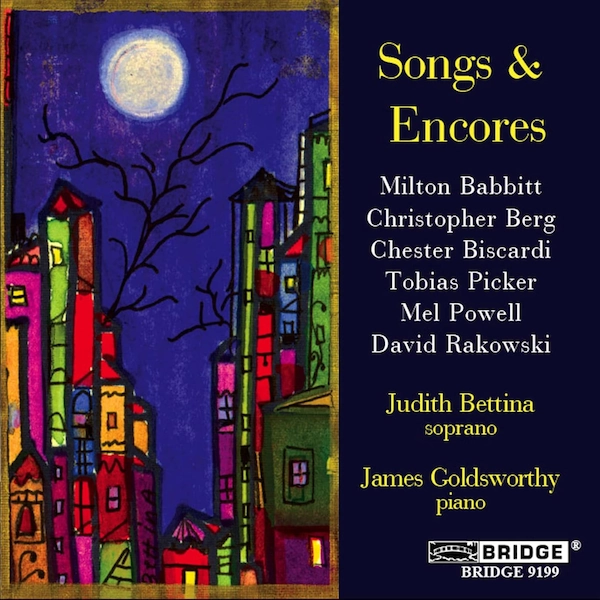
Used by permission of Bridge Records, Inc., www.bridgerecords.com, from the CD Songs & Encores, Bridge 9199.
Premiere
5 April 1995
Marylin Smart, soprano | Gary Smart, piano
Fine Arts Concert Hall, University of Wyoming at Laramie
Laramie, WY
Work Details
Duration:
ca. 3 minutes
Vocal Range:
G♯3 - F5 (Mezzo-Soprano)
C4 - A5 (Soprano)
Publisher:
Biscardi Music Press
No. B48-94-1a (Original, Mezzo-Soprano Version)
No. B48-94-1b (Soprano Version)
Distributors:
Classical Vocal Reprints
Mezzo-Soprano No. CVR3613
Soprano No. CVR3614
Theodore Front Musical Literature, Inc.
Mezzo-soprano
Soprano
Text:
Carl Sandburg (from Good Morning, America, 1928)
Dedication:
Written for Carole Everett. The work celebrates the birth of Colin Graham Everett, son of Carole and C. J. Everett.
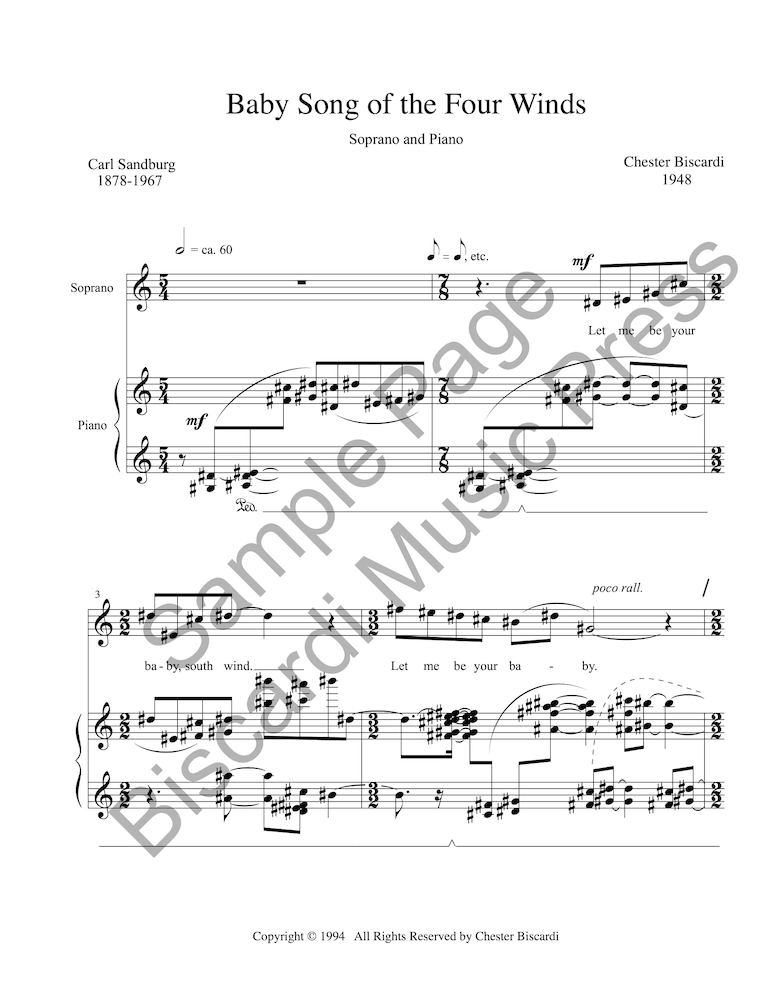
Sample Pages

Selected Press
"... lyricism is alive and well in the hands of a younger generation. Five stars."
"Biscardi's fondness for chromaticism is illustrated by the second half of his version of Carl Sandburg's Baby Song of the Four Winds."
"...effortless grace and myriad subtleties."
Click to View All Press Quotes
"This absorbing and beautifully-sung conspectus of recent American songs, largely composed in the past 20 years, covers a wide range of idioms. . . . The songs of Chester Biscardi and David Rakowski show that lyricism is alive and well in the hands of a younger generation. Five stars."
— Calum Macdonald, BBC Music Magazine (2007)
"Although two of Chester Biscardi's contributions were composed for special occasions, they were well worth recording here. Biscardi's fondness for chromaticism is illustrated by the second half of his version of Carl Sandburg's Baby Song of the Four Winds. Dreamy and moving, Recovering discreetly refers to a Bach chorale. The brief soundscape of Guru (inspired by Allen Ginsberg) completes the group."
— Peter Palmer, Tempo (2007)
Baby Song of the Four Winds was composed in 1994 in celebration of the birth of Graham Everett, son of Biscardi's friends Carole and C. J. Everett. Carl Sandburg's poem calls forth in this setting music of effortless grace and myriad subtleties. This lullaby is written, somewhat unusually, from the perspective of the baby, who addresses the four winds, inviting them to be his companions. The gentleness of the winds of the South and West is supported by a gentle oscillation between two pitches, D and E, in the piano part, which serves to underline the phrase, "rock me." The most striking departure in the poem, "North wind, shake me where I'm foolish./Shake me loose and change my ways," is mirrored by an abrupt shift to music of a much more chromatic and skittish character. At the end, in the composer's words, "the East wind brings comfort to this cycle of wakefulness and sleep."
— Hayes Biggs, Songs & Encores (2006)