
1980
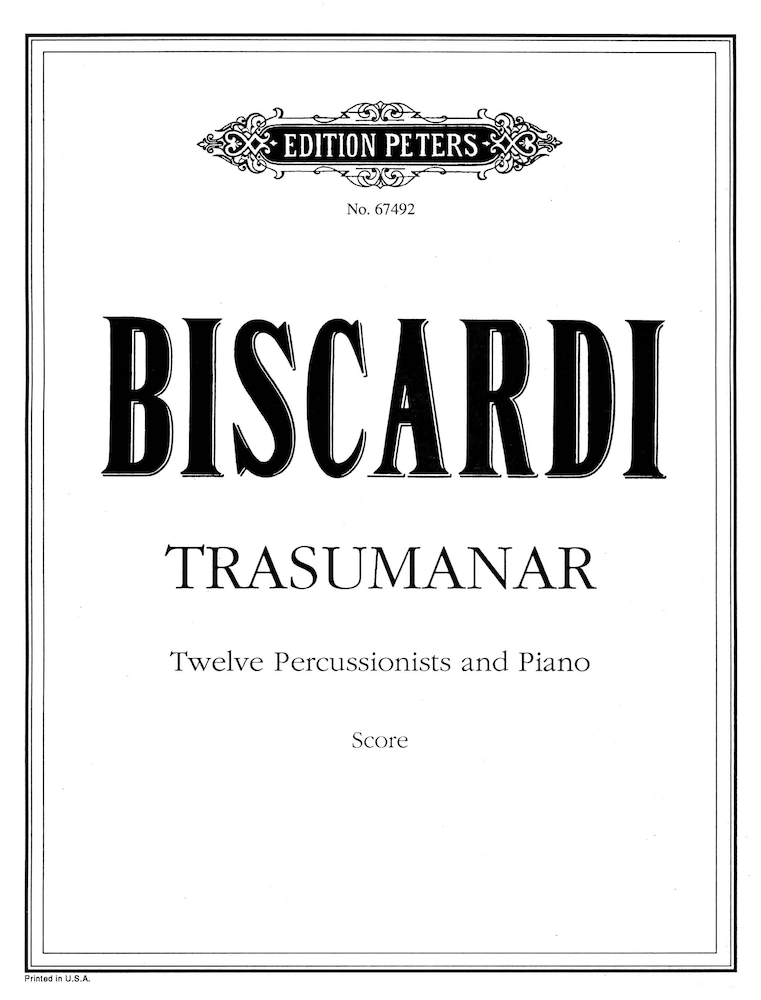
Trasumanar
for twelve percussionists and piano
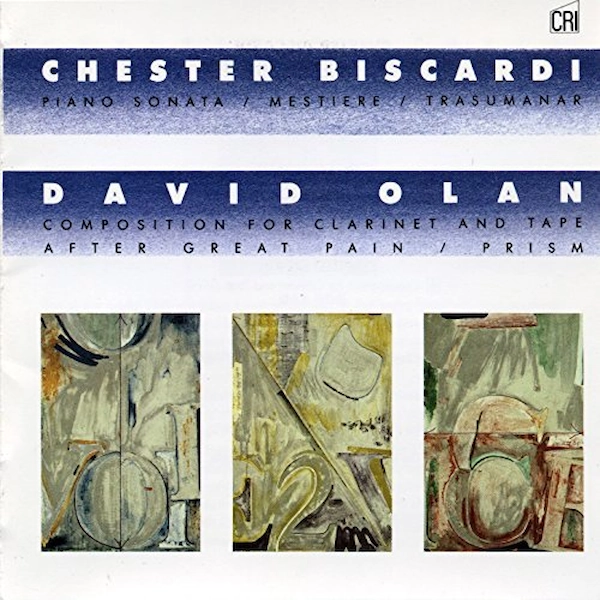
Recordings
Premiere
Premiere
6 May 1982
Buffalo Percussion Ensemble / Anthony de Mare, piano / Bruce Penner, conductor
State University of New York - Buffalo
Buffalo, NY
Midwest Premiere
15 May 1983
Northwestern Percussion Ensemble / Robert Weinrich, piano / Terry L Applebaum, conductor
Northwestern University
Evanston, IL
NYC Premiere
15 March 1983
The New Jersey Percussion Ensemble / Raymond DesRoches, conductor
Symphony Space
New York, NY
Work Details
Duration:
ca. 15 minutes
Publisher:
Commissioner
Written for The New Jersey Percussion Ensemble, Raymond DesRoches, director, under a Fellowship Grant (1979-1980) from the John Simon Guggenheim Memorial Foundation
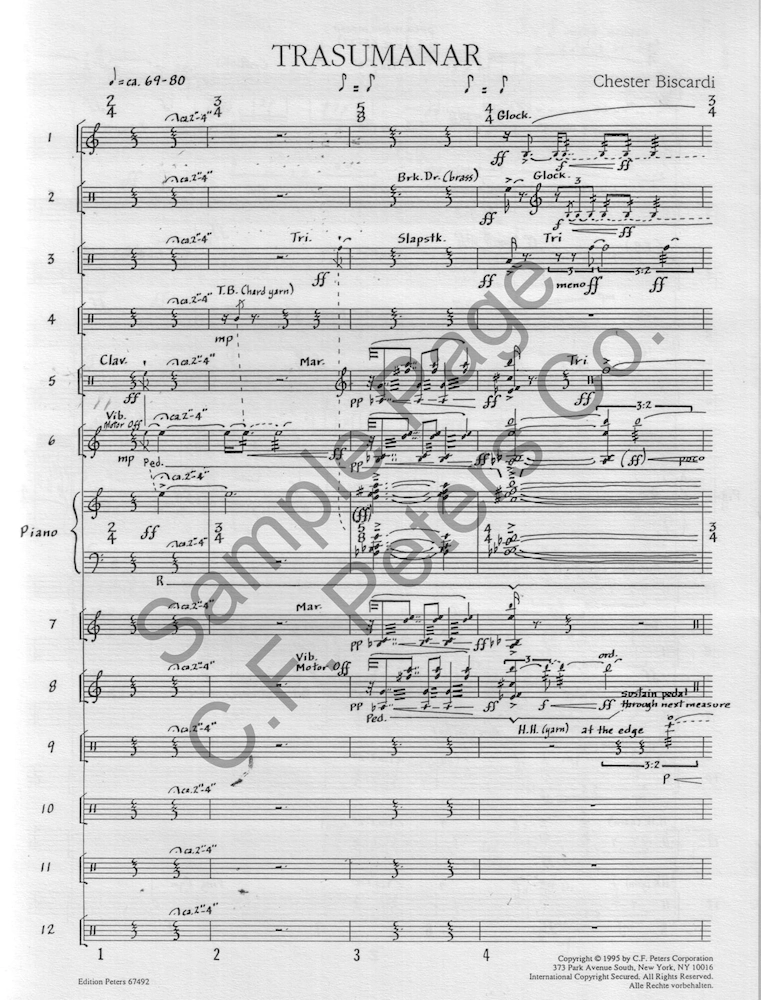
Sample Pages
Selected Press
"This major work for large percussion ensemble and orchestra contains interesting percussion writing and intriguing sounds arising from striking combinations of instruments."
"The work is full of energy, rolling whirlpools of sound and a few violent tonal geysers..."
"The listener will be treated to a visceral experience that moves from moments of relative stasis to powerful climaxes characterized by dense polyphonic stratification."
Click to View All Press Quotes
"This major work for large percussion ensemble and orchestra contains interesting percussion writing and intriguing sounds arising from striking combinations of instruments. But there is the impression that this is just yet another piece in the ubiquitous international twelve-tone style of the mid-twentieth century.
Composer Chester Biscardi (born 1948 in Kenosha, WI) is an often-honored composer who has received the Prix de Rome, an Ives Fellowship, and a Guggenheim Fellowship, and became chairman of the music department of Sarah Lawrence College. His doctorate of musical arts degree is from Yale and his master's in musical composition and his master of arts in Italian literature are from the University of Wisconsin.
It is not unexpected that several of his compositions have a connection with Italian literature, and this one is inspired by the greatest work of that literature, Dante's Divine Comedy. The poet coined the word trasumanar to describe the process or experience of being taken from the human state and rising to a state above it. Dante's narration describes the sensation of that transmutation, feeling the pull of the senses of his human nature against the spiritual yearning to transcend it.
Biscardi often finds in literary works and paintings a key not just to the descriptive content of his musical composition, but its structural or formal framework. He says this 13-minute work for 12 percussionists and piano derives its form from the opposing elements of this trasumanar process. Thus, there are elements in the music that are static, as the perceived timeless qualities of Paradise might be. These oppose dynamic, rapidly changing elements. Most of both textures appear in the percussion parts; the piano links them and gives them motion. Biscardi likens the percussion writing to the effect of the taped part of a tape-and-live-soloist work; the percussion here extends and interacts with the piano part.
Dante's progress might be suggested by the stage layout of instruments. Drums are at the rear, wooden percussion instruments are in the middle areas on the right, metal percussion instruments are in the middle left, and pitched instruments are in front. This creates a sense of movement from one state to the other, a quality that is hard to capture in just two channels.
Biscardi wrote the work for the New Jersey Percussion Ensemble, one of America's leading permanent percussion groups, and received important technical advice and assistance in scoring the work from professional percussionist Joseph Passaro."
— All Music Guide (1988)
"This is an extensively-scored work for gongs, chimes, timpani, drums, four vibraphones, piano and dozens of added cymbals, blocks and other instruments.
The work is full of energy, rolling whirlpools of sound and a few violent tonal geysers, based on certain thematic and harmonic ideas at the piano."
— John Dwyer, Buffalo Evening News (1982)
"Biscardi's work is characteristic of much of the music of the latter half of the twentieth-century in which the element of sound has been elevated to a position of eminence. He divides his large sonic palette into membranic, wooden and metallic groups, and places these in a spatial arrangement to create a sense of acoustic motion. The relationship of the piano and the percussion ensemble was suggested to the composer 'by works for piano and electronic sounds.' Here, 'the percussion functions as an electronic tape — extending, amplifying, and interacting with the sound of the piano.'
The listener will be treated to a visceral experience that moves from moments of relative stasis to powerful climaxes characterized by dense polyphonic stratification. It will be a heady experience for players and audience alike, and will test the mettle of a mature collegiate ensemble."
— John R. Raush, Percussive Arts Society (1996)